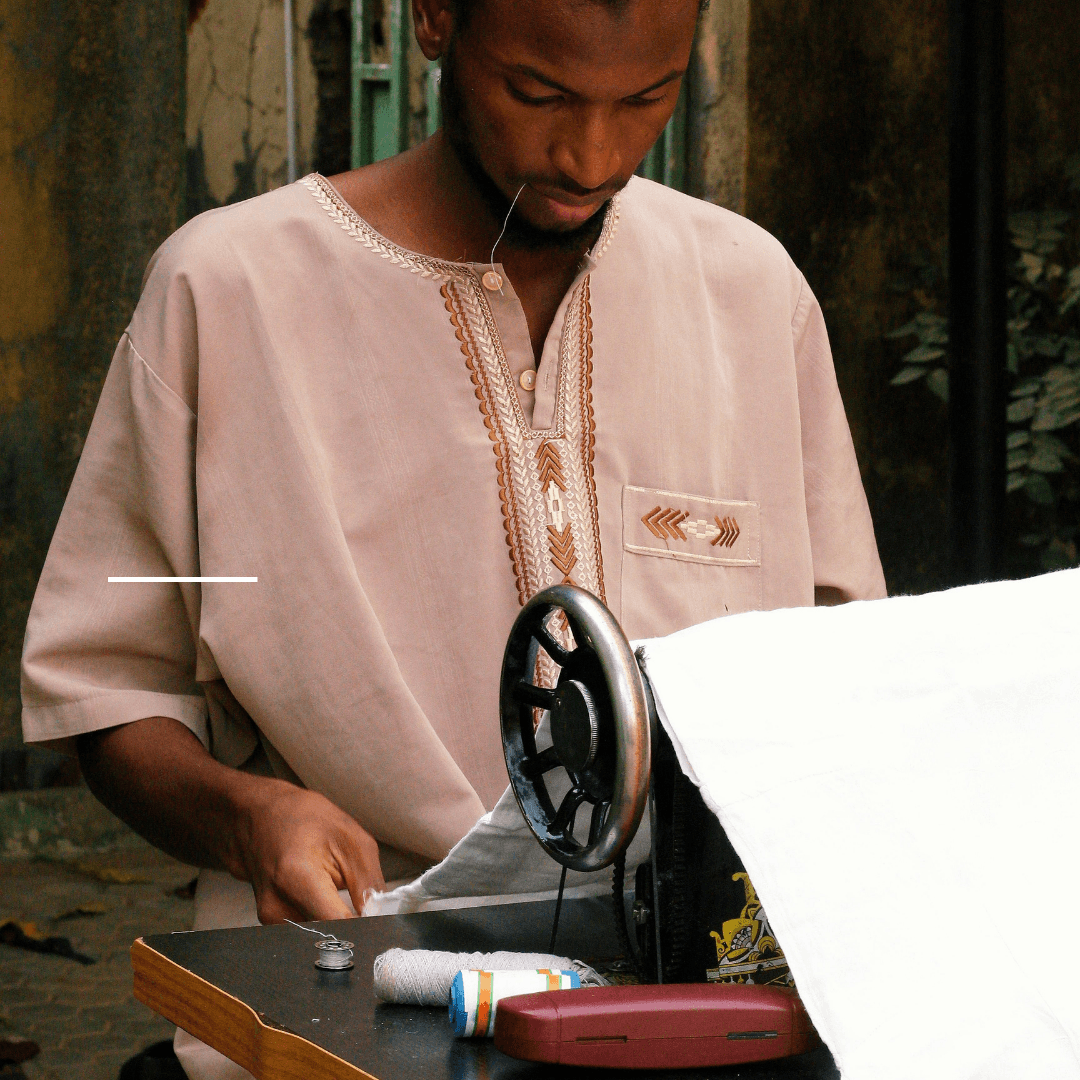
Africa's fashion economy is one of the continent's most expansive sources of livelihood, yet the overwhelming majority of those who sustain it remain legally invisible. This article examines the scale and structure of informal fashion employment across Sub-Saharan Africa, the distinct legal categories into which informal workers fall, the constitutional and human rights frameworks that support extending protection to them, and the policy instruments through which formalisation, or, where formalisation is impractical, protection, can be achieved. It argues that the exclusion of informal fashion workers from labour law is not merely a regulatory gap but a structural injustice with constitutional dimensions, and that both legal practitioners and policymakers have a responsibility to address it.
I. Introduction
Africa's fashion industry begins in the home, in the back room of a Lagos compound where a seamstress works by lamplight to finish a commission, in the Accra market stall where bolts of Kente are measured and cut, in the Nairobi workshop where a tailor produces bespoke pieces for a clientele who will never know his name. The visible, celebrated face of African fashion, the designers, the brands, the fashion weeks, rests on a vast, largely invisible infrastructure of informal labour.
That invisibility is not accidental. It is the product of legal frameworks that were designed for a different kind of economy, one characterised by large, registered employers and formally contracted workers, and that have never been meaningfully adapted to reach the fragmented, distributed, and predominantly informal reality of African fashion production. The result is a workforce of millions who work, who create economic value, and who bear significant occupational risk, but who have no enforceable legal rights arising from that work.
This article examines that invisibility from three directions. It first maps the scale and composition of the informal fashion workforce across Sub-Saharan Africa. It then analyses the legal forms that invisibility takes, arguing that informal fashion workers do not constitute a single undifferentiated category but fall into at least three distinct legal situations requiring different analytical responses. It next considers the constitutional and human rights arguments for extending protection to informal workers. Finally, it surveys the policy instruments through which formalisation, or, where full formalisation is not immediately achievable, meaningful social protection, can be extended to those the law currently does not reach.
II. The Scale of Informal Fashion Employment
The statistical contours of informal employment in Sub-Saharan Africa are well established, if often under-appreciated in their implications. The International Labour Organization estimates that between 80 and 90 percent of employment across the region is informal, meaning that workers lack formal employment contracts, social security contributions, and access to the protections that labour law nominally provides. Within the fashion sector specifically, the rate of informality is even higher than in the general economy. This is a structural feature of the industry, not an aberration: fashion production in Africa is distributed across millions of small workshops, home-based production units, market stalls, and artisan communities in which formal registration and regulatory compliance are the exception rather than the rule.
The informal fashion workforce is not monolithic. It encompasses home-based garment producers working on commission for local traders or brands; tailors operating from small single-person or family workshops; market traders selling clothing, fabric, and accessories; artisan weavers, embroiderers, and beaders producing craft fashion goods; hawkers and secondhand clothing vendors; and the vast Kantamanto-type ecosystems of secondhand clothing sorting, reselling, and upcycling that operate in Ghana, Nigeria, Kenya, and across the continent. Taken together, the employment generated by this informal fashion economy vastly exceeds the employment in formal garment factories, which tend to attract far greater regulatory attention despite representing only a fraction of the sector.
The combined employment of Africa's informal fashion economy dwarfs the employment in formal garment factories, yet it is the factories, not the workshops, that labour law has been built to reach.
Understanding the scale of this workforce is a prerequisite to understanding the scale of the legal problem. When 80 to 90 percent of a sector's workers have no effective access to labour law protection, the inadequacy of the legal framework is not a marginal concern, it is the central condition of the sector.
III. Legal Status: The Three Categories of Invisible Workers
The legal invisibility of informal fashion workers is not a single, uniform phenomenon. It takes at least three distinct legal forms, each with different implications for the kind of legal remedy or policy intervention that is appropriate. Treating these categories as interchangeable, as policy discussions often do, produces frameworks that are poorly calibrated to the actual diversity of informal work in the fashion sector.
A. The Misclassified Employee
The first and perhaps most legally straightforward category is the worker who is, under the applicable legal test, an employee, but who is not recognised, registered, or treated as one by the person they work for. The primary test for employment status across most African jurisdictions is the control test: is the putative employer directing how, when, and where the work is done? Supplementary tests, including the economic dependence test (is the worker economically dependent on a single principal?) and the integration test (is the worker's work integrated into the employer's operation?), provide further guidance.
A home-based garment worker who receives fabric from a trader, is instructed on what to make, how to make it, and by when, and is paid per piece, satisfies the control test in most African jurisdictions. She is, in law, an employee, entitled to the minimum wage, protected against unfair dismissal, eligible for statutory social security contributions. The fact that neither party to the arrangement describes it as employment, and the fact that no written contract exists, does not change her legal status. The misclassified employee is not outside the law. Her rights exist. The problem is that they exist on paper only, because they are never enforced and because she herself may not know that she has them.
This category is significant because it is the most legally actionable: the existing framework, properly applied, already protects these workers. The intervention required is not legislative reform but enforcement, the extension of labour inspectorate capacity to reach informal workplaces, the creation of accessible dispute resolution mechanisms, and critically, the legal education of workers about rights they already possess.
B. The Genuinely Self-Employed Worker
The second category is the worker who is, on any reasonable analysis, genuinely self-employed: she sets her own hours, chooses her own clients, owns her own tools, and bears the economic risk of her work. The market trader selling fabric at Balogun market in Lagos, the tailor who advertises her services independently and works for multiple clients simultaneously, the Kente weaver who sells directly to buyers, these workers are genuinely self-employed. They are not employees, and the employment law framework is not designed to reach them.
This is where the traditional labour law framework reaches its structural limit. Labour law, as it has developed across Africa and internationally, is premised on the employment relationship, on the existence of an employer who can be made responsible for the worker's conditions, remuneration, and social protection. Where no employer exists, the framework has no obvious point of application. Yet the genuinely self-employed fashion worker is a worker in every meaningful human sense: she works for a living, she faces occupational risks, she has dependants, and she has no social safety net. The law's silence on her situation is not a principled response, it is an inherited limitation that the policy agenda has increasingly recognised the need to address.
C. The Legally Invisible Worker
The third category is the most troubling, and the least discussed. It comprises the worker who does not fit any recognised legal category: the fashion apprentice who is neither an employee (she is learning a trade, not performing contracted work) nor a recognised student (she is not enrolled in any formal institution); the family member working in a fashion household business without wages or formal arrangement; the daily casual labourer hired for a market day and gone the next. For these workers, the legal framework offers essentially nothing. They are not employees who can invoke employment law. They are not self-employed persons who can invoke commercial law. And they are not students who can invoke education law. They fall through every net simultaneously.
The apprenticeship dimension of this category deserves particular attention in the African fashion context, where apprenticeship remains the primary pathway into craft fashion production, into tailoring, weaving, embroidery, and leather goods. The apprentice-master relationship in African fashion is economically important, culturally significant, and legally unregulated in most jurisdictions. Apprentices can be subjected to exploitative conditions, unpaid work extending for years, physical mistreatment, arbitrary termination, with no legal recourse, because no law governs their situation.
IV. Constitutional and Human Rights Arguments for Extending Protection
The exclusion of informal fashion workers from labour law protection is not constitutionally neutral. It exists in tension with the constitutional and human rights frameworks of virtually every Sub-Saharan African state, and there are strong legal arguments, which have been partially vindicated in litigation, for challenging that exclusion through constitutional channels.
The Right to Equality
Constitutional equality provisions prohibit discrimination on the basis of employment status. Where formal employees enjoy labour law protections that informal workers performing equivalent work are denied, the differential treatment requires justification. In South Africa, Kenya, and Ghana, constitutional equality provisions have been invoked in litigation challenging the exclusion of categories of workers from statutory protections, with mixed but encouraging results. The equality argument is particularly powerful in cases where the exclusion maps onto existing patterns of gender or race-based disadvantage: where, as in African fashion, the informal workforce is disproportionately female and the formal workforce disproportionately male, an employment status distinction that disadvantages the informal worker is also, in its practical effect, a gender distinction.
The Right to Work and Human Dignity
Article 15 of the African Charter on Human and Peoples' Rights guarantees every individual the right to work under equitable and satisfactory conditions. The Charter's guarantee is not confined to formally employed workers, it extends to everyone who works. A home-based garment worker who earns below subsistence level, works in unsafe conditions, and has no access to social protection when she falls ill or is injured is not enjoying the right to work under equitable and satisfactory conditions in any meaningful sense. The Charter's dignity provisions, and the dignity provisions of national constitutions, which are among the most expansive on the continent, similarly require that work, all work, be conducted in conditions compatible with human dignity. These provisions provide a constitutional basis for challenging working conditions in the informal fashion sector that falls below any reasonable standard of dignity, even in the absence of a formal employment relationship.
The Right to Social Security
ILO Convention 102 on Social Security and the health provisions of the African Charter together create a persuasive argument that states have an obligation to extend social protection to informal workers, not merely to formally employed ones. Several African states have made measurable progress on extending contributory social insurance to informal sector workers, including in the fashion sector. Legal practitioners and advocates can use the human rights framework to accelerate that progress, arguing that the failure to extend social protection to informal fashion workers is not merely a policy shortcoming but a violation of justiciable rights.
V. Policy Instruments for Formalisation and Protection
Formalisation of informal fashion employment is at least as much a policy challenge as a legal one. Informal employment is overwhelmingly driven by rational economic calculation: formal compliance imposes costs, social security contributions, payroll tax, written contracts, statutory leave entitlements, notice period obligations, that informal operators cannot always afford, or choose to avoid. Effective policy must engage with those incentive structures rather than simply mandating compliance and hoping for a different result. The following instruments have demonstrated evidence of effectiveness in the African context.
1. Simplified Registration and Compliance Frameworks for Micro-Enterprises
The labour law compliance architecture of most African states was designed for businesses of ten or more employees and cannot be meaningfully transposed to a single-person tailoring workshop. Simplified registration systems, flat-rate social contribution schemes, and proportionate compliance requirements, calibrated to the scale of the enterprise rather than the scale of a formal employer, reduce the barrier to formalisation without eliminating the substance of protection. Rwanda's simplified business registration regime and Ghana's recent reforms to small enterprise compliance requirements offer instructive models.
2. Tax and Social Security Integration
The principal deterrent to formalisation for many informal fashion workers is the administrative complexity and cost of social security registration. Integrating social security enrolment with tax registration, so that a fashion worker who registers to pay any form of tax is simultaneously enrolled in a social insurance scheme, removes the administrative barrier and makes social protection access automatic rather than elective. This approach has been piloted in several African jurisdictions and has shown meaningful results in increasing social insurance coverage among informal workers.
3. Cooperative Formation
Artisan fashion workers who cannot individually sustain the costs of formalisation can, through cooperative structures, achieve the collective scale at which formalisation becomes economically viable. Cooperative legal frameworks in Ghana, Kenya, and Rwanda have been used effectively to bring informal fashion workers, including Kente weavers, batik producers, and artisan jewellers, into formal economic structures while preserving their operational independence and communal production practices. The cooperative model is particularly well-suited to the fashion sector because it maps onto existing community and craft traditions.
4. Supply Chain Accountability Mechanisms
Where informal fashion workers produce goods for identifiable formal fashion brands or traders, even on an informal piece-rate basis, the formal brand can be made legally responsible for ensuring compliance along its supply chain. The 'deemed employer' doctrine, under which the formal business that benefits from informal workers' labour is treated as their employer for statutory compliance purposes, has been applied in South Africa's clothing sector to extend bargaining council coverage to outworkers and homeworkers who would otherwise fall outside the formal system. This mechanism is particularly important as African fashion brands grow and begin to operate supply chains of meaningful scale.
5. Social Protection Extension Without Full Formalisation
In the medium term, full formalisation of all informal fashion employment across Sub-Saharan Africa is not a realistic objective. A more pragmatic and immediately actionable approach extends core social protection, health insurance, pension, occupational injury compensation, to informal workers through universal or near-universal schemes funded from general taxation rather than employer contributions. This approach decouples social protection from the employment relationship, making it available regardless of a worker's legal status. Several African states have moved in this direction, and the trajectory of international social protection policy, as reflected in ILO Recommendation 204 on the Transition from the Informal to the Formal Economy, supports its further development.
VI. Conclusion
The millions of women and men who sustain Africa's informal fashion economy, who weave its cloth, cut its patterns, stitch its garments, and carry its goods to market, are workers in every sense that matters. They contribute economic value, they bear occupational risk, and they have human needs for security, dignity, and protection. That the law does not currently recognise or protect them is not a neutral fact about the world. It is a policy choice, one that can be unmade.
This article has argued that the legal invisibility of informal fashion workers takes at least three distinct forms requiring distinct responses: the enforcement of existing rights for misclassified employees, the extension of new frameworks for genuinely self-employed workers, and the development of entirely new legal categories for those who fit none of the existing ones. It has argued that the constitutional and human rights frameworks of African states already provide a legal basis for extending protection, and that legal practitioners have a role in making those arguments before courts and before policymakers.
It has also argued that legal reform alone is insufficient. Formalisation requires policy interventions that address the economic incentives driving informality, rather than simply mandating compliance with frameworks that were never designed to reach this workforce. The instruments exist. The legal arguments exist. What is required now is the political and professional will to apply them.
Africa's fashion economy will not reach its potential while the majority of those who produce it remain invisible to the law. Bringing them into legal visibility, giving them rights that are real, not merely nominal, is one of the most important tasks facing fashion law scholarship and practice on the continent today.
KEYWORDS:
Labour Law Sub-Saharan Africa
Informal Economy Fashion
Misclassified Workers Africa
Formalisation Policy Africa
Artisan Workers Legal Rights
ILO Convention 102 Africa
Fashion Apprenticeship Law
Cover Image Credit: Muhammad-Tahid Ibrahim (Pexels)