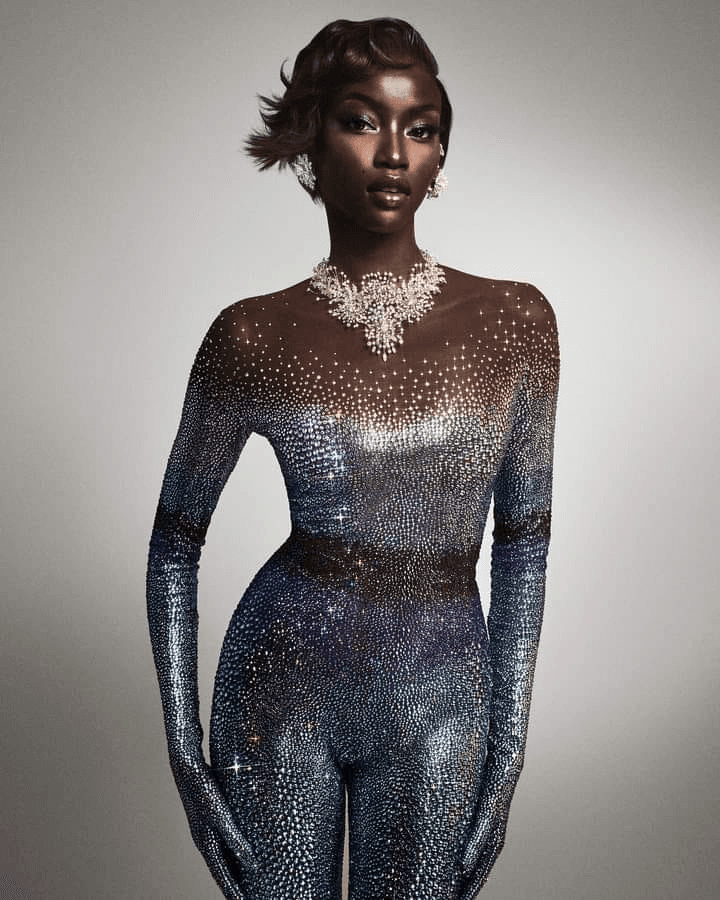
African fashion is having a moment. African designers are dressing global celebrities, building international brands from Lagos, Accra, Dakar, and Nairobi, and commanding attention at the world's most prestigious fashion weeks. The aesthetic, cultural, and commercial influence of African fashion on the global industry is more visible than it has been at any point in history.
Behind that visibility is a community of creative professionals, models, photographers, stylists, art directors, whose labour makes the imagery possible. And at the centre of that community are African models: the faces through which African fashion communicates its identity, its ambition, and its global relevance.
They are also, systematically, among the most visa-restricted professionals in the global fashion industry.
An African model booked for a campaign shoot in Milan, a runway in Paris, or an editorial in New York faces a visa application process that is lengthy, expensive, uncertain, and frequently unsuccessful, regardless of the legitimacy of the booking, the credibility of the client, or the professional standing of the applicant. And when the same model attempts to work across African borders, Lagos to Nairobi, Accra to Johannesburg, Dakar to Cairo, they often encounter comparable friction within their own continent.
This is a story about structural policy failure, and about what it costs Africa's fashion industry when the people who are supposed to be its global face cannot reliably get on a plane.
The global barrier: what African models face internationally
The fashion industry is global by design. A model based in Lagos may be booked for a shoot in London, a show in Copenhagen, and a campaign in New York within a single season. The ability to move quickly, reliably, and without administrative friction is not a luxury, it is a professional necessity.
For models from most African countries, that necessity collides with a visa regime that treats their movement as a risk to be managed rather than a contribution to be welcomed. Schengen visa applications, required for most European fashion markets, demand extensive documentation, bank statements, proof of ties to the home country, and processing times that routinely exceed the window between booking and shoot date. US visa applications are equally demanding. Gulf state work visas, while sometimes more accessible, carry their own restrictions on professional categories and employment terms.
The consequences are direct and measurable. Models lose bookings they cannot reach. Clients substitute African talent with more visa-accessible alternatives. Agencies in London, Paris, and New York that might otherwise develop African talent pipelines factor visa risk into their casting decisions before they begin. The result is a structural exclusion that operates not through explicit discrimination but through administrative friction, a system that is, in practice, designed for someone else.
The irony is sharp. Global fashion actively courts African aesthetics, African cultural references, and the commercial cachet of African provenance, while simultaneously making it structurally difficult for African professionals to participate in the industry on equal terms. The continent's creative output is welcomed. Its creative workforce is not.
"Global fashion actively courts African aesthetics and cultural references, while simultaneously making it structurally difficult for African professionals to participate in the industry on equal terms."
The intra-African barrier: a continent that cannot move within itself
If the international visa barrier is frustrating, the intra-African barrier is paradoxical. A Nigerian model seeking to work in Kenya, a Ghanaian model travelling to South Africa for a campaign, a Senegalese model booked for a shoot in Ethiopia, each of these movements, between countries that are formally committed to continental integration under the African Union and AfCFTA, is subject to visa requirements, processing delays, and administrative friction that would be unimaginable between comparable countries in the European Union.
The African Union's Agenda 2063 envisions an Africa where its citizens can move freely across the continent. The AfCFTA protocol on the free movement of persons, if implemented, would create the legal architecture for that vision. In 2022, the AU launched the Free Movement of Persons protocol, building on the existing frameworks of regional economic communities like ECOWAS in West Africa and EAC in East Africa.
The reality on the ground tells a different story. As of 2026, only a handful of African countries offer visa-free or visa-on-arrival access to all other African passport holders. The Mo Ibrahim Foundation and other continental bodies have documented repeatedly that African citizens face more barriers to intra-African movement than nationals of any other continent face within their own regions. An African passport is, by several measures, among the least powerful travel documents in the world for intra-continental movement.
For African models and creative professionals, this means that the continental market, fifty-four countries, 1.4 billion people, and a growing middle class with significant appetite for African fashion content, is not practically accessible. A model cannot build a pan-African career if pan-African movement requires navigating fifty-four different visa regimes.
The AfCFTA gap: promise without implementation
The African Continental Free Trade Area is the most ambitious economic integration project in the continent's history. Its trade in goods and services protocols, its investment framework, and its protocol on intellectual property all create significant opportunities for Africa's fashion industry. But the protocol that matters most for the movement of creative professionals, free movement of persons, remains the least implemented.
This is not an accident. Free movement of persons is politically the most sensitive of AfCFTA's protocols. Governments that are willing to liberalise tariffs on textiles are considerably less willing to commit to open borders for workers. The political economy of migration, fears about labour market displacement, security concerns, and the domestic politics of border control, consistently outweighs the economic case for mobility.
The economic case, however, is real. Research on the returns to creative economy integration consistently shows that the movement of creative talent generates economic multipliers that extend well beyond the individuals involved. A model working in Nairobi from Lagos brings her network, her client relationships, and her international experience into the Kenyan market. A photographer travelling from Accra to Johannesburg for a shoot contributes to the South African creative economy and takes knowledge and connections back to Ghana. These exchanges are the building blocks of the continental creative economy that AfCFTA is supposed to enable.
The failure to implement free movement of persons is not a minor implementation gap. For Africa's fashion industry, it is the single largest structural barrier to continental integration, more significant, in practice, than any tariff or trade rule.
"The failure to implement free movement of persons is not a minor implementation gap. For Africa's fashion industry, it is the single largest structural barrier to continental integration."
Creative professionals as a specific policy category
One of the reasons visa policy fails African models and creative workers so consistently is that the legal frameworks governing their movement were not designed with them in mind. Visa regimes distinguish between tourists, business travellers, and long-term workers, categories that do not map cleanly onto the reality of creative professional work, which is project-based, short-duration, internationally mobile, and dependent on timing in ways that standard visa processing timescales cannot accommodate.
A model booked for a three-day shoot in Paris needs a visa that can be obtained in days, not weeks. A stylist travelling to Lagos for a campaign needs a framework that recognises their professional status without requiring them to navigate a business visa process designed for corporate executives. A photographer working across four African countries in a single month needs a regional access framework, not four separate visa applications.
Several regions have developed specific visa categories or fast-track processes for creative professionals. The EU's short-stay visa framework includes provisions for cultural workers and artists. The UK's creative worker visa route, while imperfect, at least recognises creative professionals as a distinct category. In Africa, comparable frameworks are almost entirely absent, both at the national level and within regional economic community protocols.
The policy gap here is specific and addressable. What is needed is not the elimination of all border controls, it is the creation of legal frameworks that recognise the distinct characteristics of creative professional work and build visa and mobility systems around those characteristics, rather than forcing creative professionals into categories that were designed for different kinds of movement.
What this costs Africa's fashion industry
The costs of visa barriers to African fashion are not abstract. They accumulate across the industry in ways that compound over time.
Lost bookings and revenue. Every visa refusal or delay that causes a model to miss a booking is lost income for the model, lost value for the client, and a signal to the global industry that African talent is unreliable to book, through no fault of the talent themselves.
Talent drain and diaspora dependency. African models who build international careers frequently do so by relocating to visa-accessible jurisdictions, London, Paris, New York, rather than building their careers from their home countries. The continent loses the economic and cultural value of their careers to cities that were simply easier to work from.
Weakened global positioning. African fashion's global moment is partly a visibility moment, it depends on African faces, African aesthetics, and African creative professionals being present in the global industry. Visa barriers directly constrain that presence and, over time, constrain the industry's ability to sustain and build on its current momentum.
Suppressed continental market development. The intra-African barrier suppresses the development of the continental fashion market that AfCFTA is supposed to enable. Pan-African campaigns, continental fashion weeks, and cross-border creative collaborations are all harder to execute when the people involved cannot reliably move between countries.
The policy agenda: what needs to change
The visa barriers facing African models and creative professionals are a policy problem, which means they are a policy solution. The frameworks that create the barriers can be changed. What is required is the political will to change them, and the institutional advocacy to make that case effectively.
At the continental level: the AU and AfCFTA must accelerate implementation of the free movement of persons protocol, with specific attention to creative professionals as a policy category. The creative economy should be explicitly named in AfCFTA's service sector commitments as a priority area for mobility liberalisation.
At the regional level: ECOWAS, EAC, SADC, and other regional economic communities should develop fast-track mobility frameworks for creative professionals, modelled on the EU's cultural worker provisions but designed for African contexts and African industry dynamics.
At the bilateral level: African countries with significant fashion industries, Nigeria, South Africa, Ghana, Kenya, Senegal, Egypt, should develop bilateral mobility agreements specifically covering creative professionals, including models, photographers, stylists, and art directors.
In diplomatic engagement with global fashion markets: African governments and the AU should engage directly with the EU, UK, US, and Gulf states on visa frameworks for African creative professionals. The case is strong: African talent contributes economically and culturally to global fashion markets, and visa barriers that exclude them are bad for the industries those markets are trying to develop.
At the industry level: African fashion weeks, fashion councils, and industry associations should collectively document and publicise the impact of visa barriers on African creative professionals, building the evidence base that makes the policy case and amplifying the voices of the models and creatives most directly affected.
Conclusion: the face of African fashion should be able to travel
African fashion's global moment is real. The designers, the aesthetics, the cultural authority, these are not manufactured narratives. They are the product of decades of creative work by African professionals building an industry that the world is now paying attention to.
But a global moment requires global access. It requires the models, photographers, and creative professionals who give African fashion its face and its visual language to be able to move, to Paris and Milan and New York, yes, but also to Nairobi and Johannesburg and Dakar and Cairo. It requires the continental market that AfCFTA promises to be accessible not just in trade statistics but in the practical reality of creative professionals building pan-African careers.
The visa barriers that currently prevent this are not inevitable features of how the world works. They are policy choices, choices made by governments that have not yet been given a sufficiently clear and forceful case for why changing them serves their interests. Making that case is part of what ALFA exists to do.
Africa's fashion industry deserves the freedom of movement that its global ambition requires. The policy frameworks to enable that movement are buildable. The political will to build them is the work ahead.
Tags: African Models · Visa Policy · Freedom of Movement · AfCFTA · African Fashion · Creative Economy · Fashion Policy · Labour Rights · ALFA · Cultural Economy · Soft Power · Fashion Industry · Migration Policy · Creative Professionals · Alliance for Law and Fashion in Africa
Cover Image Credit: Fashion Network