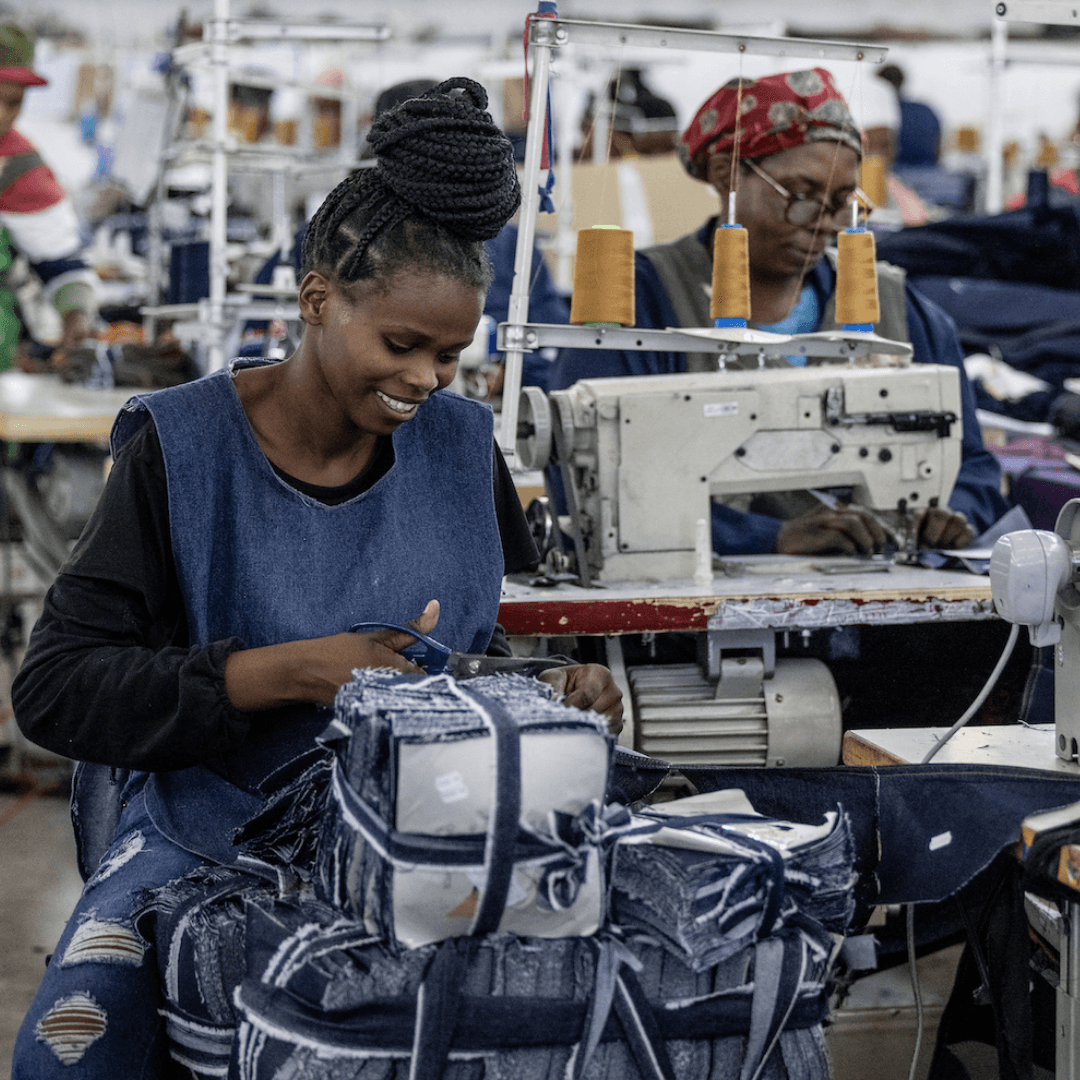
In the garment factories of Maseru, the textile mills of Hawassa, the export processing zones of Mombasa, and the production workshops of Port Said, a significant proportion of the workforce was not born in the country where they work. They crossed a border, in some cases multiple borders, to get there. They brought skills, labour, and economic need. They built industries. And in most cases, they did so within legal frameworks that were never designed with them in mind.
Labour migration is a structural feature of Africa's fashion manufacturing sector. The cross-border movement of workers powers some of the continent's most significant garment and textile industries, fills the skills gaps that domestic labour markets cannot always supply, and enables the kind of regional economic integration that policymakers have been trying to formalise for decades through instruments like the African Continental Free Trade Area.
Yet the legal and policy frameworks governing this reality, the migration law, the labour protections, the bilateral agreements, the social security arrangements, remain fragmented, inconsistent, and in many cases entirely absent. The result is an industry built on a workforce that is, in legal terms, largely invisible.
This article examines what is happening, where the policy gaps are most acute, and what the AfCFTA moment offers as an opportunity to finally build the legal infrastructure that cross-border fashion manufacturing needs.
The Movement of Labour That Powers African Fashion
Africa's garment and textile manufacturing sector has never been contained by national borders. From the earliest expansion of export-oriented manufacturing in the 1990s, driven partly by AGOA and partly by bilateral investment frameworks, factories were built with the expectation that labour would move to fill them.
In Lesotho, a country with a small domestic population, the garment sector at its peak employed tens of thousands of workers, a significant proportion of whom had migrated from neighbouring South Africa, Mozambique, and Zimbabwe. In Ethiopia's Hawassa Industrial Park, one of the continent's most ambitious manufacturing zones, workers were recruited from across regional states, many of them migrating internally but navigating the same structural challenges as cross-border migrants: unfamiliar legal environments, limited social protection, and employment contracts they lacked the resources or knowledge to enforce.
In Egypt's textile corridor along the Nile Delta, and in Kenya's export processing zones around Nairobi and Mombasa, similar patterns hold. Workers move to where the manufacturing is. The manufacturing concentrates where infrastructure, trade access, and investment incentives intersect. And the legal frameworks, on both sides of most borders, have not kept pace with either.
"Labour migration is not a peripheral feature of Africa's fashion manufacturing sector. It is structural, and the legal frameworks governing it have not kept pace with the economic reality."
Cross-Border Manufacturing Hubs: What Exists and What is Emerging
Several clusters across Africa have developed into de facto cross-border manufacturing hubs, areas where production, labour, and trade flows converge across national boundaries, even when the formal legal infrastructure for that convergence does not exist.
The Lesotho–South Africa corridor: Lesotho's garment sector has historically been intertwined with South African capital, logistics, and labour markets. Workers move across the Caledon River. Finished garments move out through South African ports. The two economies are deeply integrated in practice, but the legal frameworks governing that integration, including labour protections for migrant workers and social security portability, remain largely uncoordinated.
The Ethiopia–Kenya–Tanzania corridor: East Africa's emerging manufacturing belt connects Ethiopia's industrial parks with Kenya's export processing zones and Tanzania's growing textile sector. The proposed Lamu Port–South Sudan–Ethiopia Transport (LAPSSET) corridor and existing road networks facilitate the movement of goods and, increasingly, workers. Legal harmonisation across these three jurisdictions remains a work in progress.
The Egypt–North Africa textile belt: Egypt's mature textile industry, one of the largest on the continent, increasingly draws on labour from Sudan, Libya, and across North Africa. The legal frameworks governing this movement are complex, inconsistently applied, and rarely designed with the fashion and textile sector specifically in mind.
West Africa's emerging production cluster: ECOWAS's free movement protocols have created conditions for cross-border labour mobility across West Africa. Ghana, Nigeria, Senegal, and Côte d'Ivoire are all developing fashion manufacturing capacity. The legal infrastructure for regional manufacturing integration exists in outline, but implementation is uneven and sector-specific frameworks are absent.
What these corridors have in common is significant: production logic that is already regional, legal frameworks that are still national, and workers who navigate the gap between the two entirely on their own.
The Policy and Legal Gaps: Where Workers Fall Through
For workers in cross-border manufacturing contexts, the legal gaps are not abstract. They are the difference between having recourse when wages go unpaid and having none. Between qualifying for healthcare and being turned away. Between being able to organise collectively and being deportable for attempting to do so.
The gaps cluster around four areas:
Labour law applicability. In most African jurisdictions, labour law protections, minimum wage, occupational health and safety, unfair dismissal protections, collective bargaining rights, apply to workers employed within the territory, regardless of nationality. In practice, however, migrant workers in the informal or semi-formal manufacturing sector frequently fall outside enforcement reach. Employers exploit the gap between legal entitlement and practical enforcement, knowing that workers with uncertain immigration status are unlikely to lodge complaints with labour inspectorates.
Social security portability. Workers who migrate across borders to work in garment factories typically cannot access social security benefits, pensions, healthcare, maternity protection, that accumulate in one country when they return to another. Bilateral social security agreements between African countries are rare, particularly in the fashion and textile sector. Workers who spend a decade contributing to a pension scheme in Lesotho return to Mozambique with nothing to show for it.
Immigration status and employment rights. The relationship between immigration status and labour rights is a critical vulnerability. Workers without formal immigration status are often unable to enforce employment rights, not because those rights do not legally exist, but because exercising them risks exposure to immigration enforcement. This dynamic gives employers significant leverage and suppresses the enforcement of protections that exist on paper.
Skills recognition and certification. Workers who develop skills, pattern cutting, specialist finishing, quality control, in one country's manufacturing sector cannot easily have those skills formally recognised when they move to another. The absence of mutual recognition frameworks for vocational qualifications means that experienced workers are frequently reclassified as unskilled when they cross a border, with corresponding impacts on wages and conditions.
"Workers who spend a decade building skills and contributing to an economy cross back across a border with no portable rights, no recognised qualifications, and no legal continuity. That is a policy design failure, and it is one that can be fixed."
The AfCFTA Opportunity: Building the Regional Framework Africa Needs
The African Continental Free Trade Area represents the most significant opportunity in a generation to address these structural gaps, not just in trade, but in the legal architecture that governs how people, skills, and production move across the continent.
AfCFTA's Phase II negotiations include a protocol on the free movement of persons, which, if implemented meaningfully, would create a framework for the kind of cross-border labour mobility that Africa's fashion manufacturing sector already depends on. The Protocol on Women and Youth in Trade explicitly addresses the participation of women in the continental economy; given that the majority of workers in African garment manufacturing are women, this is directly relevant.
But AfCFTA's potential in this space will only be realised if three things happen alongside trade liberalisation:
Harmonised labour standards. As intra-African trade in garments and textiles expands, there is a strong case for minimum continental standards on wages, working conditions, and labour rights in the fashion manufacturing sector. Without them, trade liberalisation risks driving a race to the bottom, with production concentrating in whichever jurisdiction offers the lowest labour costs and the weakest protections.
Sector-specific migration frameworks. The fashion and textile sector has specific labour dynamics, seasonal production cycles, specialist skills, geographically concentrated manufacturing hubs, that generic migration frameworks do not adequately address. AfCFTA's protocols need to be complemented by sector-specific agreements that recognise these dynamics and build protections around them.
Regional social security coordination. Building on existing bilateral agreements and ECOWAS frameworks, AfCFTA should drive the development of a continental approach to social security portability, ensuring that workers who migrate within Africa to contribute to the fashion economy do not do so at the cost of their long-term economic security.
Country Cases: Three Models, Three Lessons
The experiences of three countries illustrate both the scale of the challenge and the directions in which solutions might develop.
Lesotho: the cost of dependency without protection. Lesotho's garment sector was built on trade preference access and migrant labour. At its height it was a genuine development success story. But as AGOA uncertainty has demonstrated, an industry built on external preferences and a workforce without portable rights is an industry without a foundation. The lesson from Lesotho is not that trade preferences are bad, it is that they must be accompanied by the legal infrastructure that allows workers and industries to survive when those preferences shift.
Ethiopia: industrial ambition and the governance deficit. Ethiopia's industrial parks, particularly Hawassa, attracted significant international investment and created substantial employment. But reports of poor working conditions, high turnover, and inadequate labour protections have complicated the development narrative. Ethiopia's experience illustrates that manufacturing scale and labour protection must develop together. Industrial policy that outpaces governance capacity creates vulnerabilities that eventually undermine the investment case itself.
Kenya: EPZ lessons and the regional opportunity. Kenya's export processing zones have a longer track record and a more developed legal framework than many comparable facilities on the continent. Labour law applies within EPZs, and Kenya's bilateral engagement with its East African neighbours creates at least the foundation of a regional approach. The lesson from Kenya is that the legal infrastructure can be built, the question is whether the political will exists to extend it across borders and ensure it is genuinely enforced.
What Needs to Happen: The Policy Agenda
The path from the current fragmented reality to a regional framework that works for workers, manufacturers, and the industry as a whole requires action at multiple levels simultaneously.
At the national level: governments in the key manufacturing countries need to audit the gap between legal protections on paper and enforcement in practice, with specific attention to migrant workers in the garment and textile sector. Labour inspectorates need the capacity and the mandate to reach workers regardless of immigration status.
At the bilateral level: countries that share manufacturing corridors, Lesotho and South Africa, Ethiopia and Kenya, Ghana and Côte d'Ivoire, should develop bilateral agreements specifically addressing labour migration in the fashion and textile sector, including social security portability, skills recognition, and joint enforcement mechanisms.
At the continental level: AfCFTA's protocols on persons and trade need to be implemented with the fashion manufacturing sector explicitly in view. The AU and AfCFTA Secretariat should convene sector-specific working groups that bring together governments, industry bodies, and workers' organisations to develop the harmonised standards the sector needs.
At the industry level: fashion councils, manufacturers' associations, and brands sourcing from African production hubs have both the incentive and the responsibility to advocate for the legal frameworks that protect their supply chains and the workers within them. An industry that benefits from cross-border labour mobility cannot be neutral on the question of whether that mobility is legally protected.
Conclusion: Building for the Movement That Already Exists
Africa's fashion manufacturing sector is already regional. Workers already cross borders. Production already flows across jurisdictions. The economic integration that AfCFTA aspires to formalise is, in the garment and textile sector, already a practical reality.
The question is not whether to build cross-border manufacturing hubs. They exist. The question is whether to build the legal infrastructure that makes them work, that protects the workers who power them, recognises the skills they bring, and ensures that the value they create is distributed fairly across the regional economies they connect.
That infrastructure is buildable. The bilateral frameworks, continental protocols, and sector-specific agreements that would constitute it are not beyond reach. What they require is the same thing that every gap in African fashion policy requires: sustained, informed, and industry-specific policy attention from governments that understand the stakes.
Africa's fashion manufacturing workers are not asking for protection that does not exist elsewhere in the world. They are asking for the same legal continuity, the same portable rights, and the same enforcement mechanisms that workers in comparable industries in other regions already have. Building that is not charity. It is the foundation on which a genuinely competitive, sustainable, and equitable African fashion manufacturing sector can be built.
TAGS:
Labour Migration · Cross-Border Manufacturing · African Fashion · AfCFTA · Worker Rights · Trade Policy · Fashion Policy · Garment Industry · Labour Law · Industrial Policy · Lesotho · Ethiopia · Kenya · Egypt · ALFA · Informal Workers · Social Security · Regional Integration · Fashion Manufacturing · Alliance for Law and Fashion in Africa
Cover Image Credit: Pexels